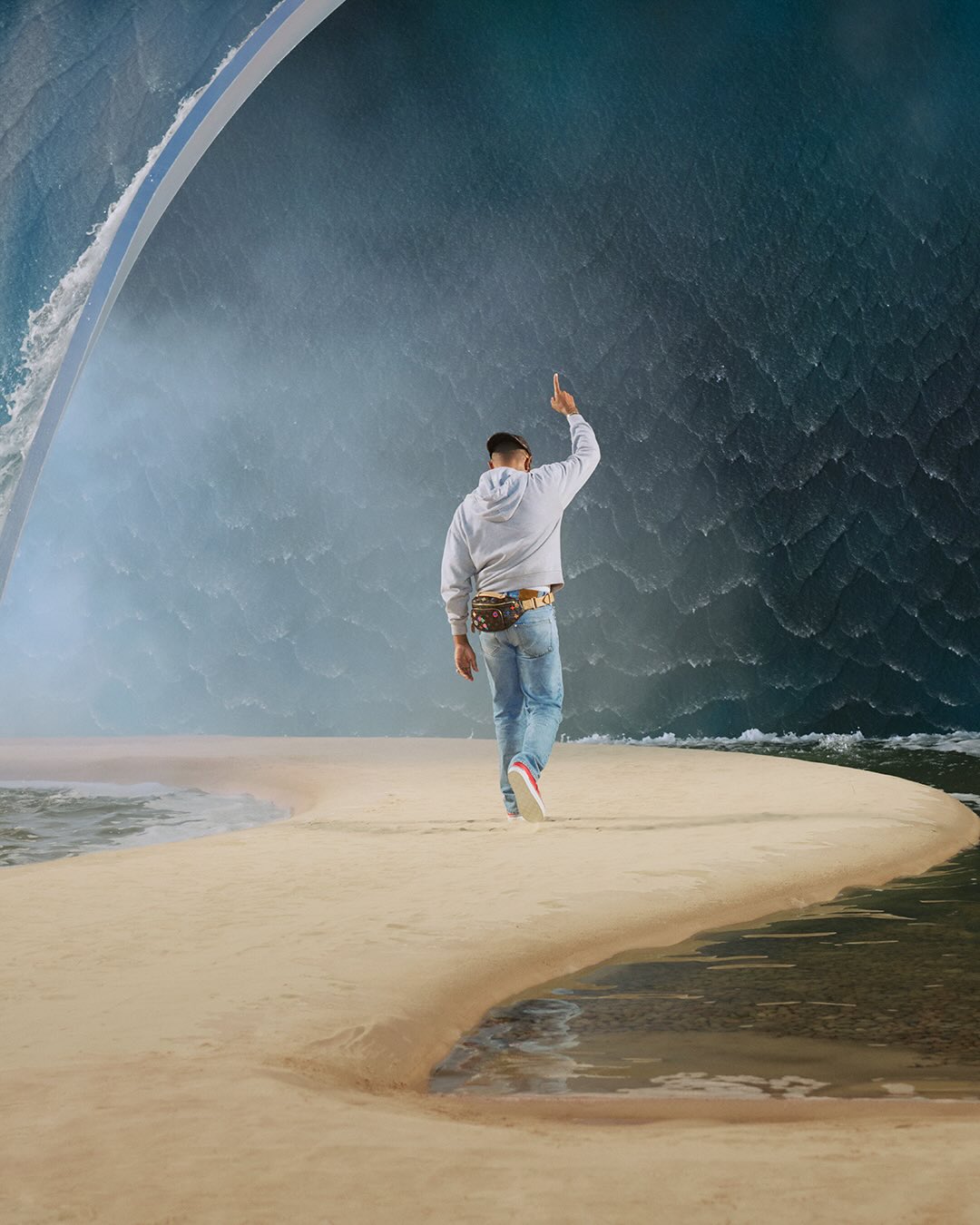
Pharrell built a beach and a 37-metre wave at a Paris university and staged a fashion show inside it. The clothes were secondary. That was the point.
- The show is now the primary cultural text. The product is the detail work inside it. Brands leading with product inside a spectacular context are building in the wrong sequence.
- Spectacle without accumulated authority is expensive theater. It produces press but not the cultural authority that converts.
- The question isn't how to build a bigger show. It's what story you've accumulated long enough that a spectacle could be the latest chapter.
Pharrell's Louis Vuitton SS27 show was staged at the Cité Internationale Universitaire de Paris. The grounds were transformed into an outdoor beach: boardwalk, fine sand, and an 8-meter-tall, 37-meter-wide artificial tidal wave that models emerged from during the runway. A surf-and-skate-themed collection, inside a set built to match its scale. It was a story that happened to include fashion.
The distinction matters.
The coverage that followed was almost entirely about the spectacle. The wave. The logistics of building a beach on the grounds of a university campus. The scale of the set. The clothes were secondary in the conversation, because the frame was larger than the garments inside it. Pharrell built a world and placed the collection inside it, and the world was what people talked about first.
The Show Is the Product Now
When the spectacle is the first thing people discuss, the clothes the second, and the brand the third: fashion has crossed into entertainment. The sequence used to run differently. You showed the collection. The collection communicated the brand's position. The show was a delivery mechanism. The spectacle was set dressing.
Pharrell has collapsed the distance between show and substance. The show is the argument. The SS27 presentation at the Cité Internationale was a primary cultural text, and the product line was the detail work that lived inside it.
Fashion has always staged shows, but what Pharrell is doing is structurally different. The question is whether the event is proof of something or a substitute for something. Those two things look identical from a distance. They perform completely differently in the market.
What It Means for Brands Without Pharrell
The danger in the Pharrell read is that it looks replicable. Artificial wave. Constructed beach. Scale. Spectacle. Put enough budget behind it and you have the same outcome. That logic is structurally wrong, and it is already producing expensive failures at the mid-tier of the luxury market.
The reason the LV SS27 show worked is because Pharrell has actual cultural authority, built over thirty years across music, production, design, and taste-making at a level the market consistently validated before he ever touched a fashion house. The show was the latest chapter in a story the audience already knew. The constructed beach was a spectacular venue for a story that had been accumulating credibility since the nineties.
Spectacle without that accumulation behind it is expensive theater. It produces views and press, but it does not produce the specific kind of cultural authority that makes people want to be inside a brand's world. The audience can feel the difference between a show that is the expression of something real and a show that is the substitute for something missing. The second type performs at the announcement level. It does not convert.
The question for every brand watching the SS27 coverage is what story they have been building long enough that a spectacular event could be the latest chapter rather than the opening sentence.
The brands that will own this moment are the ones who treat the spectacle as a proof point, not a press release. A show that makes the product feel secondary is a show that's doing its job.
The New Luxury Grammar
The wave was the runway. The clothes were secondary. The brand was primary. That sequence (venue, clothes, brand) is the new luxury grammar. It runs in the opposite direction from how most brand teams are trained to think.
The traditional model: lead with product, support with context. The new model: lead with world, let the product live inside it. The first model produces campaigns. The second produces cultural events. Cultural events accumulate into brand equity in a way that campaigns cannot replicate, regardless of budget.
The brands trying to reverse this sequence (leading with product inside a spectacular context, hoping the spectacle transfers meaning to the object) are already behind. The audience has already learned to separate the show from the brand authority behind it. When the authority is real, the spectacle amplifies it. When the authority is thin, the spectacle reveals the thinness.
Pharrell staged the collection behind a 37-meter artificial wave in Paris and the brand got bigger. That happened because of everything that came before the river. The brands watching and planning their own spectacular moments would do well to ask what they have accumulated before they start scouting locations.
