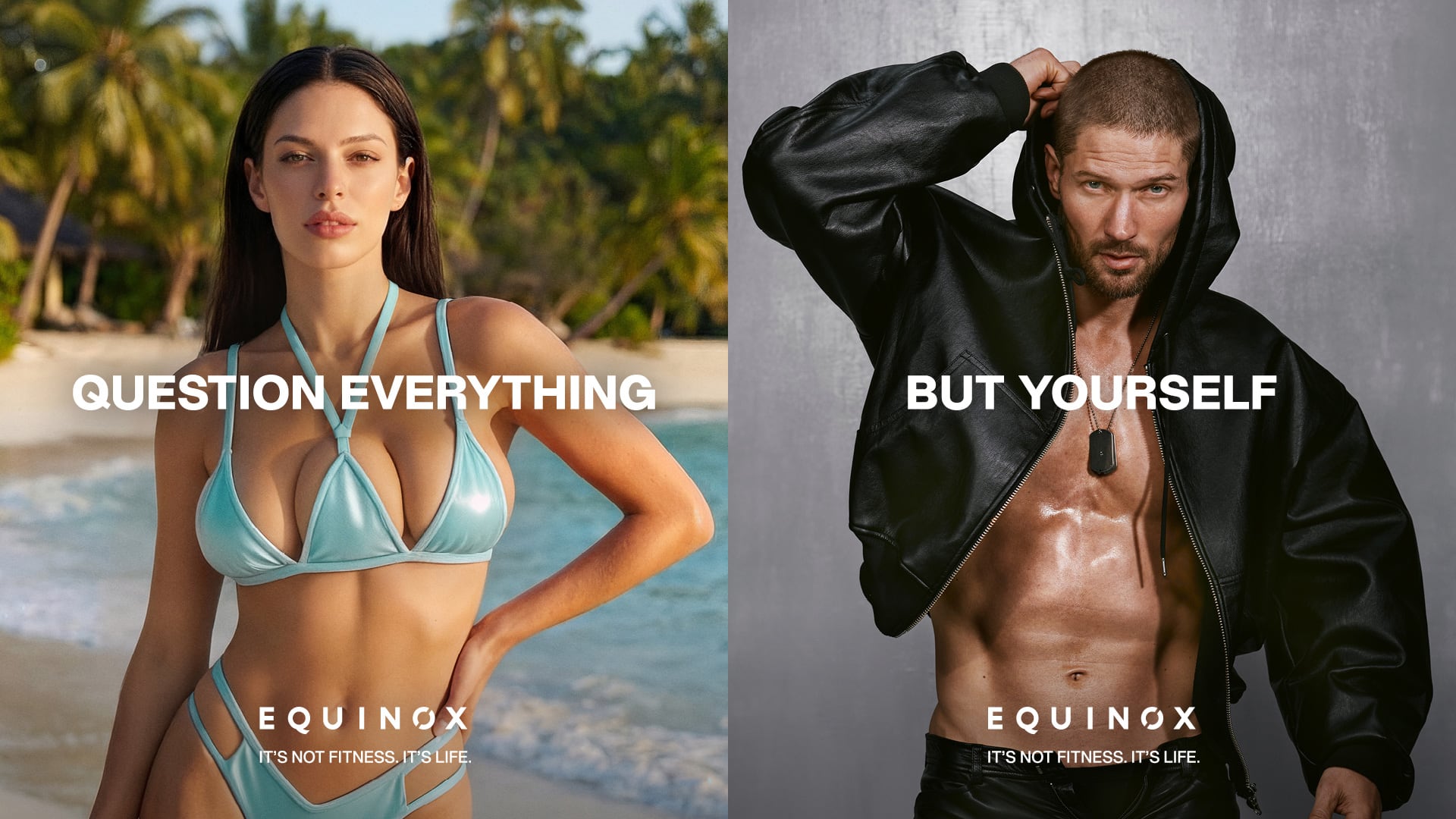
"Made by humans" has hardened from a sentiment into a genre. Aerie, Dove, Porsche, Equinox, and Panda Express are running the same human-made campaign, which puts the position one saturation cycle from becoming background noise, the way "clean" and "sustainable" did. The decode: the backlash was never about AI quality. Some AI ads test as well as human ones. It is about mismatch, using an impersonal technology where a brand's equity is emotional. So the risk is not using AI. It is using it in the wrong place.
- The stance is now a template: Aerie and Dove pledged no AI, Porsche ran a hand-drawn holiday campaign, Panda Express made a human-made animated short, and Equinox built "Question Everything But Yourself" around unfiltered portraits.
- The gap driving it: 82% of ad execs think Gen Z and millennials view AI ads positively; only 45% of those consumers do. Gartner expects one in five brands to position on the absence of AI by 2027.
- The backlash is not about quality. When Coca-Cola's AI ad drew fire, people were reacting to the mismatch between decades of emotional equity and a technology that feels impersonal, not to the output.
Aerie pledged no AI. So did Dove. Porsche drew its holiday campaign by hand. Panda Express commissioned a human-made animated short. Equinox built a whole campaign, "Question Everything But Yourself," around unfiltered human faces set against synthetic ones. Five brands, five categories, one move. "Made by humans" is no longer a feeling. It is a genre.
A genre is a repeatable creative template, and repeatable is the problem. The first anti-AI ad read as conviction. The fiftieth reads as a category badge. This is the arc that flattened "sustainable," "clean," and "simple." Each began as a differentiator and ended as table stakes, a word every brand in the aisle was effectively required to say. Gartner already expects one in five brands to position on the absence of AI by 2027. When one in five brands says the same thing, none of them is saying anything. The genre is a year, maybe two, from being wallpaper.
The Backlash Was Never About Quality
Here is the part almost everyone rushing into the genre gets wrong. The AI backlash is not a referendum on AI's output. The work is often fine. In head-to-head tests, some AI ads pull click-through rates a hair under human ones, 0.76 percent against 0.65 percent, close enough that no consumer could pick the machine blind. When Coca-Cola's AI holiday spot drew fire, the research was clear that people were not reacting to the quality of the animation. They were reacting to the mismatch between a brand that spent a century building deep emotional associations and a technology that reads as impersonal. The offense was not that it looked bad. It was that it felt automated, coming from a brand whose entire value is that it feels like something.
Coca-Cola's AI-generated 2025 "Holidays Are Coming" ad, the spot that drew the backlash. Watch on YouTube.
That reframes the problem. If the issue were quality, the fix would be better prompts. It is not, so it is not. The Swinburne research Forbes cites found that AI-content aversion largely disappeared when a brand demonstrated responsible human leadership and genuine commitment behind the work. The audience is not rejecting the tool. It is rejecting the tool in the one place they came to feel something.
The risk was never using AI. It was using it where your brand's equity is emotional.
The Trap Inside the Pledge
Which is why the blanket "no AI" pledge is a weaker position than it looks. First, it is a hostage. Almost every brand that swears off AI in its ads is using AI somewhere behind them, in research, ideation, media buying, versioning. As one executive put it, scratch below the surface and AI is being used everywhere. A pledge fronted by a celebrity is only as true as the weakest node in a supply chain nobody audited, and the day a reporter finds that node, the campaign becomes a hypocrisy story. Second, it is copyable. "We don't use AI" is a sentence any competitor can print in a press release by Friday. A claim that costs nothing to match is not a moat. It is a coupon everyone can clip.
Aerie's "100% Real" pledge, fronted by Pamela Anderson: "You can't prompt this." Watch on YouTube.
What the Careful Brands Are Actually Doing
The durable version is not abstinence. It is precision. The move is to draw a line through your own brand and know which side of it every decision falls on. Automate the operational, the parts no one was ever going to feel: the media plan, the resizing, the thousand versions of a banner. Protect the emotional, the parts that are the entire reason anyone trusts you: the film that lands, the voice, the hand. Then be able to prove which is which. The winning claim in two years is not "we don't use AI." It is "we know exactly where our brand is allowed to be a machine, and this was never that place." That position is built on self-knowledge, and self-knowledge does not fit in a competitor's press release.
Porsche understood the line. It handed the same holiday slot Coca-Cola automated to a Paris animation studio and made "The Coded Love Letter" by hand, a 2D film with eight references to its own racing history buried in the frames. It never said the words "no AI." It did not have to. The craft was the claim, and the film went viral precisely because it could only have been made by people who cared.
Porsche's hand-drawn "Coded Love Letter," the same holiday slot Coca-Cola automated. It went viral for looking human-made. Watch on YouTube.
Before you run the human-made ad, run the audit. Map every place your brand touches a customer and mark each one emotional or operational. Put AI everywhere on the operational side and keep it off the emotional side, then be able to show the line. The brands that win the next two years will not be the ones that abstained from AI. They will be the ones that could prove, line by line, that they used it everywhere it did not matter and nowhere it did.
The anti-AI genre has a problem it cannot see. It is a template, run the same way by every brand that adopts it, which makes it the most impersonal, copy-paste move on the board. The thing built to prove a brand still feels human is turning into the machine-made sameness it was protesting. The stance was never the answer. Knowing where you are allowed to feel automated was.
